Equipment and systems
Forklift wheel cleaning system
Every forklift that comes in from a yard or a loading bay carries whatever was on the ground outside into the building on its tyres. A wheel cleaning system is a passive barrier laid into the floor at that transition, which takes dirt, grit and moisture off the wheels as the vehicle drives over it, without stopping the vehicle and without anyone having to do anything.

Mechanical wheel cleaning at critical entry points
These systems work as a barrier between the dirty and the clean side of a site. Multi-directional brush strips scrape the tyres as vehicles pass at their normal operating speed, so the protection is continuous and does not depend on anyone remembering to do it, on a power supply or on a break in the workflow.
That makes them a fit for distribution centres and high traffic warehouses where the cost of dirt is counted in cleaning hours, floor wear and slip risk, and for manufacturing and engineering plants where grit carried in from a yard ends up in a process it was never meant to reach. Where what has to be kept out is microbiological rather than visible, the wet version of the same product is the one to specify, and Rejuva publishes it separately as industrial disinfection mats.

How a wheel cleaning system works
Modular panels sit flush with the existing floor at the entry point. Each panel holds angled, tension sprung bristles that scrape debris from the tyres as a vehicle rolls across, and the bristles flex under the load and spring back afterwards, which is what keeps the cleaning effective over a long service life. What comes off the wheels falls into a collection tray under the grid.
Nothing is consumed in the process and nothing is applied to the tyre. The dirt, dust and grit that the brushes lift out of the tread are held in the tray until it is emptied, which is the whole of the maintenance routine and the reason a dry field costs nothing to run once it is in.
It needs no electrical supply, which matters at loading bay doors where power is rarely where you want it, and it asks the driver to stop, reverse or change the approach at no point.
The system in motion
A brush field is easier to judge in motion than in a photograph, so the clip below shows what the stills cannot: a wheel turning across the bristles at normal speed, the tread being worked from several angles at once, and the debris ending up in the tray instead of on the floor inside.
The video is streamed from YouTube in its privacy-enhanced mode, and nothing is loaded from YouTube until you press play. From that point Google's privacy policy applies.
Why facility managers install one
The argument differs by site, but it usually comes down to three things a wheel cleaning system changes at the door rather than after the fact.
-
Less dirt to clean up
Dirt that never gets past the door does not have to be scrubbed off later, which shows up as fewer machine passes, less wear on the floor finish and longer intervals between deep cleans. How much it saves depends on the traffic, the yard surface and the weather the site works in.
-
A floor that keeps its finish
Grit driven across a slab under load is what wears a floor coating through, and a resin or polished concrete finish is expensive to lay again. Taking the abrasive off at the door is cheaper than taking the consequences off the maintenance budget later.
-
Fewer wet and dirty tyre tracks
Wet, dirty tracks running away from a doorway are one of the ways an otherwise sound floor becomes slippery, and they are worst on exactly the routes that carry the most traffic. Taking the water and the dirt off at the entrance addresses the cause instead of the symptom.
-
Maintenance that stays simple
The collection trays are emptied and the panels are hosed down, and that is the whole routine. It is a task for one person, and individual panels lift out for cleaning or replacement without touching the rest of the field.

The engineering behind brush based cleaning
The principle is simple and the execution is not: bristles are set at opposing angles so that a rolling tyre is worked from several directions at once, which dislodges particles that a single plane brush leaves in the tread.
The material is chosen to balance stiffness, so that the bristle scrapes rather than bends away, against flex memory, so that it returns to its original angle after each compression instead of laying flat. That combination is what keeps performance consistent across a long life rather than for a first season.
No electrical input is involved at any point. The cleaning force is the weight of the vehicle pressing the bristles against the tyre as it turns, which is also why the running cost is limited to the maintenance routine and why the system works where there is no power at the door.
Where it earns its place
Any operation that moves goods between an outdoor and an indoor zone carries dirt across that line on its tyres. Three cases make the argument on their own.
-
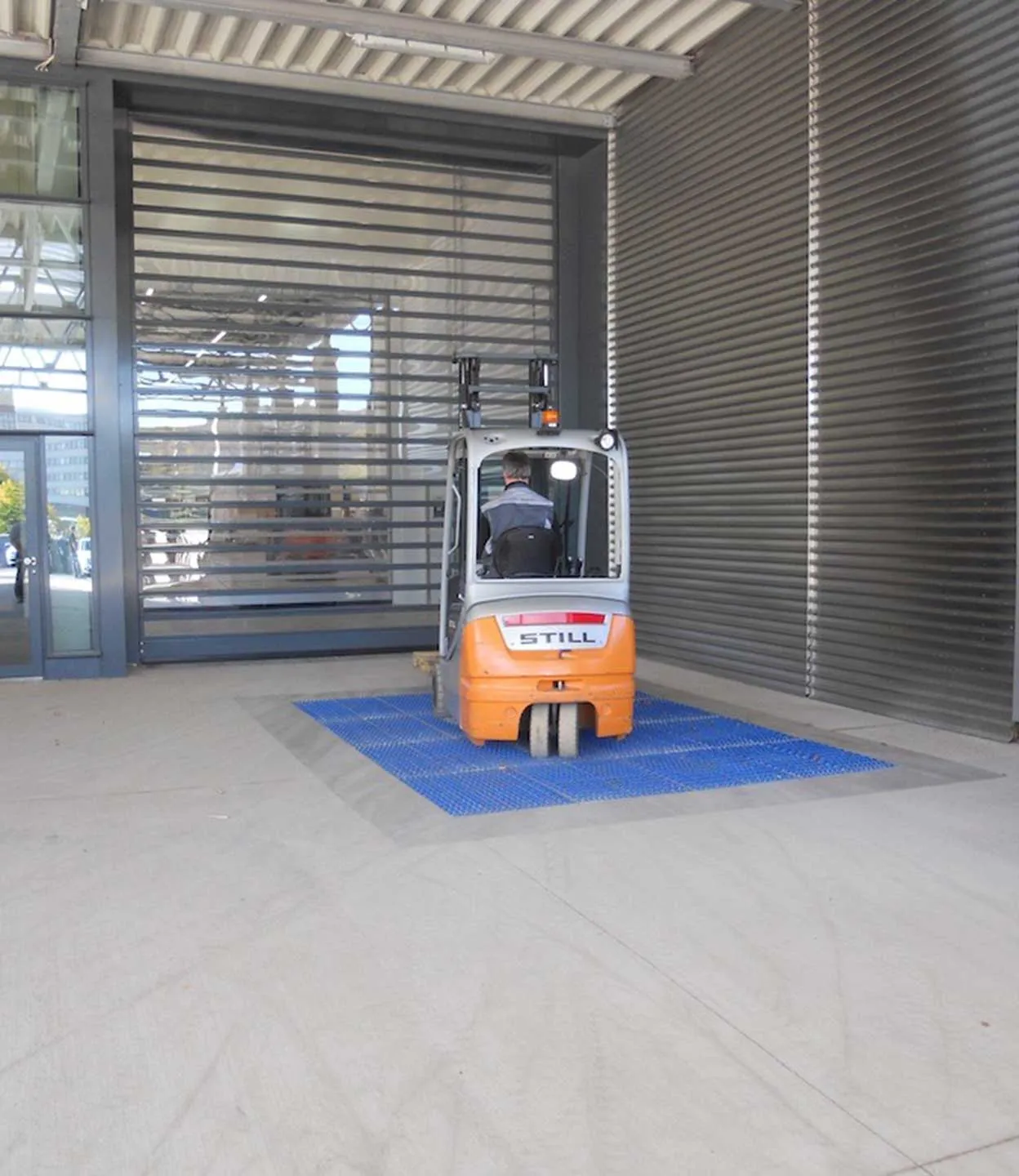
High volume logistics
A distribution centre running around the clock cannot stop forklifts for a manual wheel wash, and the vehicles cross between the bay and the racked area many times a shift. A passive system cleans on every pass without slowing anything down.
-
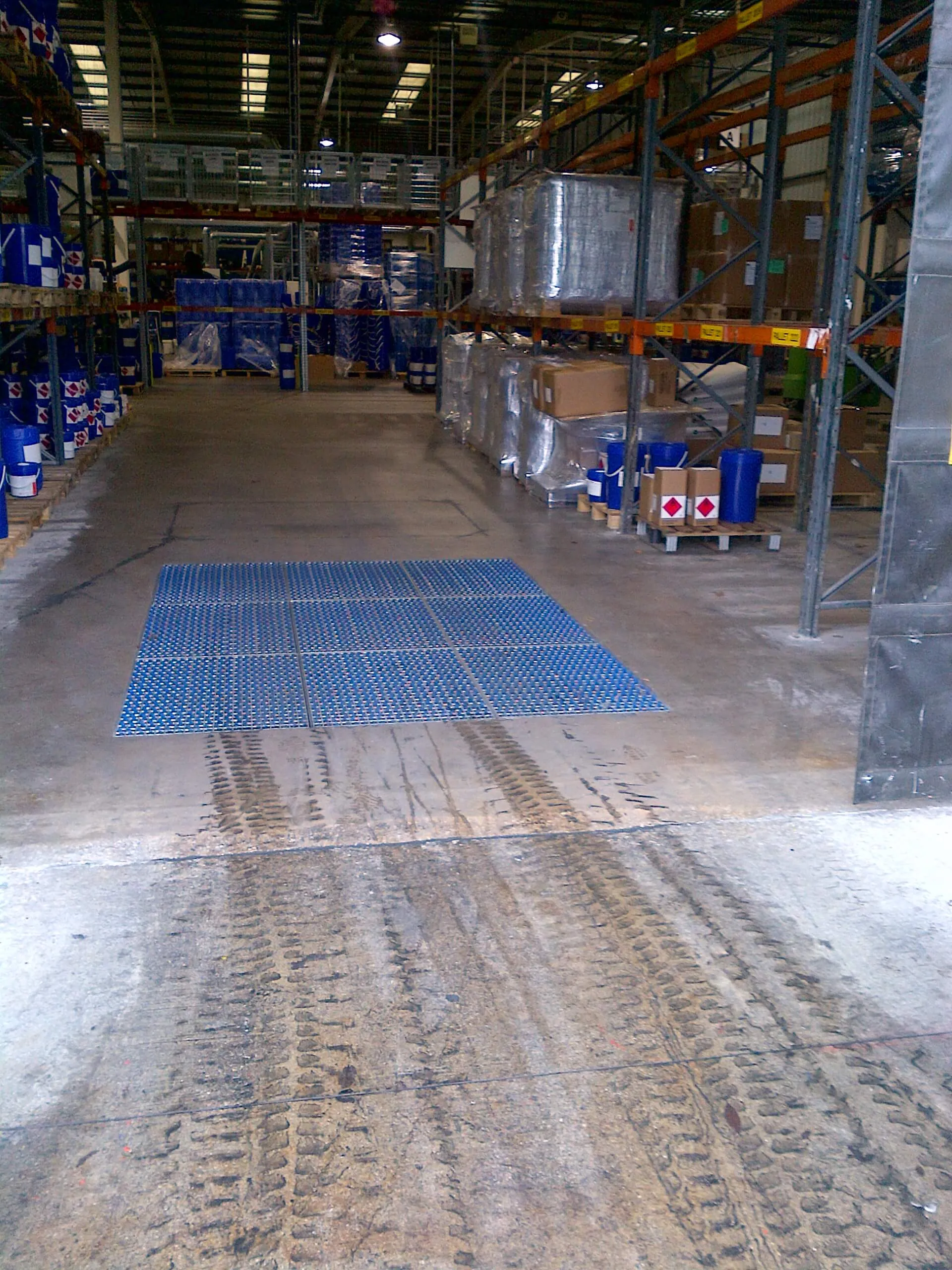
Manufacturing and engineering
Grit and swarf carried in from a yard end up in machinery, in tolerances and on assembled work, and they are cheapest to deal with at the point they come in rather than at the point they are found.
-
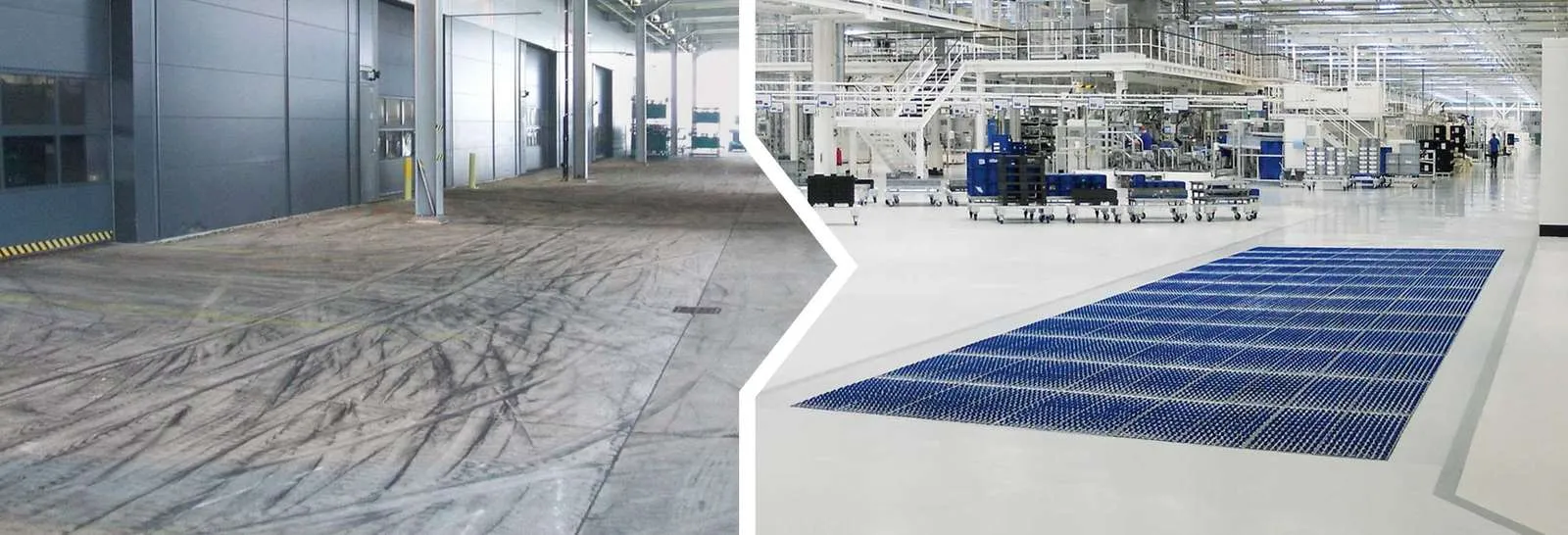
Sites with a yard that gets weather
Where the outside surface is gravel, hardstanding or anything that holds water, the tyre picks up a new load on every trip out. That is the case where a dry field pays for itself fastest, because the volume coming in is constant rather than occasional.


Tested, and by whom
The dry system was measured by the Fraunhofer IPA Institute, which found 80 to 90 percent of contamination removed under normal traffic conditions.
That is the number Rejuva will quote, with the institute and the conditions attached, because a removal rate belongs to a tested system and not to a brochure. What a given entrance achieves depends on the traffic, the contamination it carries and how the field is sized, and that is what the site survey establishes.
The panels themselves carry anti-slip and flame resistance certification for wet industrial environments, which is what allows a field to be laid in a doorway that has water running through it in winter.
DIN EN ISO 13287, DIN 51130 and DIN 51131 for slip resistance, DIN EN 13501-1 for reaction to fire.
Installing it in a working building
The standard installation sets modular panels into a recessed frame so that the finished surface is continuous with the floor and there is nothing to trip over. That involves cutting or forming a shallow recess at the entry point, and most sites schedule it outside operating hours, although the modular construction allows the field to be laid in stages where the door cannot be closed at all.
Where the building is leased, or the installation is meant to move with the operation, surface mounted frames sit on top of the existing floor with ramped edges instead. They clean in the same way, and the point to check before choosing them is the clearance under the door and where the water goes.
- How long the work takes depends on the substrate and on how many entrances are treated, which the survey establishes rather than a catalogue.
Controlling what gets into the building
Two other things Rejuva installs at the same boundary, for the sites where the dry field is one part of a wider question about what comes in.
-
Industrial disinfection mats
The wet half of the same product. The brushes do the same mechanical work over a tray of disinfectant, so the surfaces are cleaned and disinfected in one crossing, for the sites audited on a microbiological load rather than on dirt.
-
Industrial air purifiers
The same argument applied to what is airborne rather than what is on the floor, for the halls where dust, welding fume or odour is the load that has to come down.
Frequently asked questions
Does the system slow down forklift operations?
No. Vehicles cross at their normal operating speed and the cleaning happens as the wheels turn over the bristles, so there is nothing for the driver to do differently: no stopping, no reversing and no change of approach.
When should we be looking at the wet system instead?
When what has to be kept out of the clean side is microbiological rather than visible, which in practice means food production, pharmaceutical manufacturing, laboratories and anywhere a hygiene audit asks what control sits at the threshold. The mechanical part is identical; the wet version adds a disinfectant tray under the brushes and is published as industrial disinfection mats.
What if we lease our building and cannot modify the floor?
Surface mounted frames sit on top of the existing floor with ramped edges, need no excavation and can be lifted and taken with you if the operation moves. They clean in the same way as a recessed field.
How long do the bristles last before they need replacing?
Long enough that replacement is a planned job rather than an incident, and the wear is gradual, so cleaning becomes visibly less effective before anything fails. Individual panels are replaced on their own without lifting the rest of the field. What a specific site should expect depends on its traffic, which is part of what the survey looks at.
Can it be installed outdoors or in a cold store?
Yes, in covered loading bays, at external doors and in temperature controlled areas, provided the version is specified for the conditions and the drainage is designed with the installation rather than after it. Tell us where it is going and we will confirm the specification for that position.
Do we need special tyres or any modification to the trucks?
None. The system works with pneumatic, solid rubber, polyurethane and cushion tyres, and with pallet trucks, counterbalance forklifts, reach trucks and powered pallet jacks alike. The panels take loads of up to 40 tonnes, which covers every forklift and reach truck and most of what arrives on a yard, so what needs checking is the weight of the heaviest vehicle that will cross rather than what it runs on.
How does this compare with sticky mats or washing the wheels by hand?
A disposable mat is too short for the wheel to turn across it more than once, so the tread is never really worked, and it is a consumable that has to be bought and thrown away. Washing by hand takes people off other work, interrupts the flow and depends on who is on shift. A brush field cleans every vehicle that crosses it, in the same way, all day.
What maintenance does it actually need?
Emptying the debris trays and hosing the panels down. There is no solution to change, no filter and no consumable, so it is a routine task for one person and needs no special tools.
How long does the field have to be?
Longer than most people expect, because the wheel has to turn several times across the brush surface for the tread to be worked properly. That makes the length a function of the wheel diameter and the traffic rather than of the width of the door, and it is the single thing most often got wrong when a field is specified from a catalogue.
Related services
Projects rarely stop at one discipline. These are the services most often planned alongside this one.

Have a project in mind?
Describe what needs to happen in the building and we will come back with a proposed approach, the specialist who would carry it out and a budget you can work with.