Safety and compliance
Line marking for warehouses and factories
Marking is what tells a driver, a forklift operator and a visitor where they may go, and it does it without a word of any language. When it fades, the building stops explaining itself and people start improvising.

What Rejuva marks, and where
Rejuva is an industrial line marking service working across Europe in warehouses, factories, logistics centres and the car parks around them. A project covers the survey of the floor that is already there, the layout drawn against the standard that applies in that country, the application itself and the handover, and it is run as one piece rather than split between a designer and a painter.
What separates that from calling a general contractor is that the floor is surveyed before anything is quoted. A substrate that will not hold paint, a slab that still moves or a coating that has to come off first all change the answer, and none of them are visible in a photograph of the building.
Why line marking matters
Warehouses, factories and logistics centres are busy places where pedestrians and heavy equipment share the same floor, often at speed. Clear markings direct people and vehicles around the site, which is the cheapest safety measure available to most buildings and usually the first one to wear out.
There is also a duty behind it. Floor markings are required to indicate emergency exits, walkways, loading and unloading zones and restricted areas, and the detail of what is required is set nationally rather than at European level, so the standard that applies is the one in the country the building sits in.
Where we mark
Each of these is read separately because they are marked to different rules, in different materials and around different working hours.
-
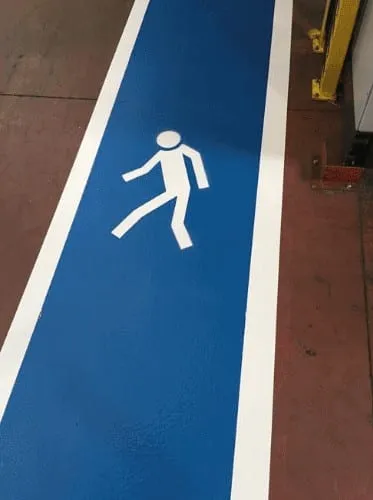
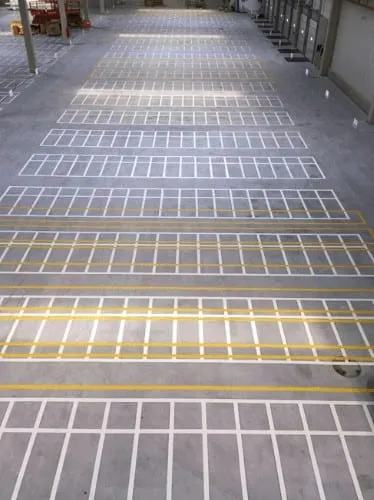
Warehouse and factory floor marking
Traffic lanes, walkways, storage zones and hazard areas laid out so that a new starter can read the floor on their first day.
-
Car park line marking
Bays, arrows, crossings and disabled spaces, set out to use the surface you have rather than the surface a standard layout assumes.


What epoxy marking is for
Epoxy marking applies a durable resin to the floor rather than a paint film, which produces lines that stay visible under abrasion and where chemicals are present. It is the choice for areas with heavy traffic, and it costs more at the outset precisely because it is not repainted every season.
Where the layout changes often, tape and floor markers do the same job with far less commitment, and are quick to lift when the zones move again. Which of the two a floor gets is a question about how settled the layout is, not about quality.
What we install
-
Painted and epoxy lines
The permanent scheme, applied to a prepared floor so that it bonds and stays put under forklift traffic.
-
Floor markers and pictograms
Arrows, footprints, hazard symbols and zone identifiers, which carry instructions to people who do not share a language.
-
Safety tape
High-visibility tape for temporary layouts or for a zone that is still being tried out, quick to apply and quick to replace.
The buildings we work in
-
Industrial warehouses
Warehouse line marking separates the traffic routes from the picking faces and gives every zone an edge, which is what stops stock spreading into an aisle it was never meant to reach.
-
Factories
Factory line marking identifies the hazardous areas around moving machinery and assembly lines, and defines where a person may stand while the line is running.
-
Logistics centres
Instructions for the movement and storage of goods, which is where throughput is won and lost.
-
Car parks
Designated bays, pedestrian crossings and traffic flow, marked to the rules that apply to the site and its users.
How a line marking scheme is decided
Two floors of the same size rarely take the same scheme, so the line marking solutions Rejuva proposes come out of the survey rather than out of a catalogue.
- Rejuva surveys the floor before quoting, because the substrate decides what will hold and for how long.
- The scheme is set out against the standard that applies where the building is, not against a generic template.
- Colours, widths and marking types are chosen for the site rather than offered as a fixed range.
- Work is scheduled around your operation, including outside production hours, since a floor being marked is a floor nobody can use.
Related services
Projects rarely stop at one discipline. These are the services most often planned alongside this one.

Have a project in mind?
Describe what needs to happen in the building and we will come back with a proposed approach, the specialist who would carry it out and a budget you can work with.