Equipment and systems
Industrial disinfection mats
A disinfection mat is a wet cleaning field set into the floor at the point where handling equipment crosses from one hygiene zone into another. As the forklift rolls over it, angled brushes work the tread while a disinfectant solution held in the tray beneath wets the surfaces the brushes have just opened up, so that the vehicle is cleaned and disinfected in a single pass that nobody has to remember to carry out.

Cleaning and disinfecting in the same crossing
On a site where hygiene decides what may be produced, the doorway is where a hygiene plan is either enforced on every crossing or enforced on the crossings somebody happened to think about. Rejuva installs disinfection mats at exactly that line, because a permanent field is the only control at a threshold that treats the tenth forklift of the shift the same way it treated the first.
The difference from a dry brush field is not the brushes but what sits under them. A dry system takes off what is loose, which is the right answer where the problem is grit, dust and the water that comes in off a yard. A wet system does the same mechanical work and then wets the cleaned surface with disinfectant, which is what a site working under HACCP, BRC or IFS needs at the point where traffic crosses between a raw side and a finished side.
What gets installed at the doorway
The installation is a shallow assembly built into the floor, and the order of its parts is what makes the two actions happen in one crossing.
-
A stainless tray set into the floor
A tray is recessed into the slab at the transition, sized to the width of the opening and to the traffic that uses it, and it is what holds both the solution and everything the brushes take off.
-
Filled with water and disinfectant
The tray is filled to the working level with water and a disinfectant suited to the site, at the concentration that product is approved for, which is a decision for whoever writes the hygiene plan rather than for the equipment.
-
A load bearing grid above it
Over the tray sits a grid carrying angled nylon bristles set at several lengths, finished flush with the surrounding floor so that there is nothing for a pallet truck to catch on.
-
The tread is opened as the wheel turns
When a forklift crosses, its own weight presses the bristles against the tyre and they work it from several directions at once, which lifts out the particles that sit down in the tread pattern and that a flat surface never reaches.
-
The solution wets what has been cleaned
In the same movement the disinfectant is carried onto the surfaces the brushes have just opened, which is the reason the two steps are one step: disinfecting a tyre before the dirt is off it treats the dirt and not the tyre.
-
Everything drains back into the tray
Loosened dirt, particles and the excess liquid run back down into the tray, and they leave the building when the solution is changed and the tray is emptied.
The panels take loads of up to 40 tonnes, which covers every counterbalance forklift and reach truck and most of what else crosses a threshold, and the version to install follows the heaviest vehicle that will actually drive over it. The length of the field follows the wheel diameter and the traffic, because the wheel has to turn more than once across the brushes for the tread to be worked properly.
What changes on a site that is audited on hygiene
The argument for a wet field is rarely about the dirt you can see, which is why it is made on different sites than the dry one.
-
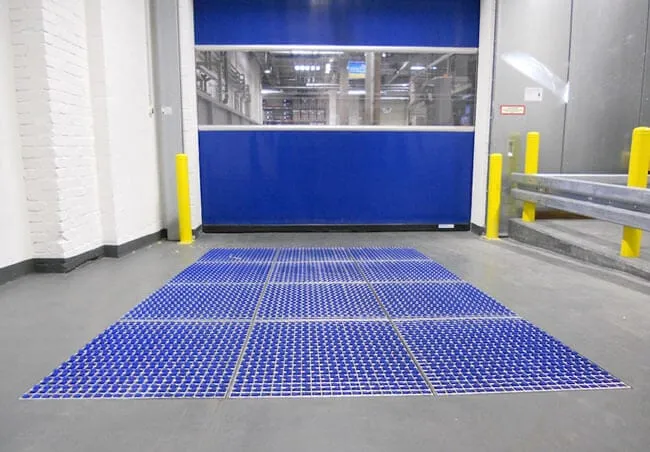
A control an auditor can stand in front of
BRC Global Standard v9, IFS Food and the prerequisite programmes underneath HACCP all expect a hygiene control where traffic crosses between zones. A permanent installation at that point can be written into the procedure, photographed and evidenced, which a manual routine that depends on the shift cannot.
-
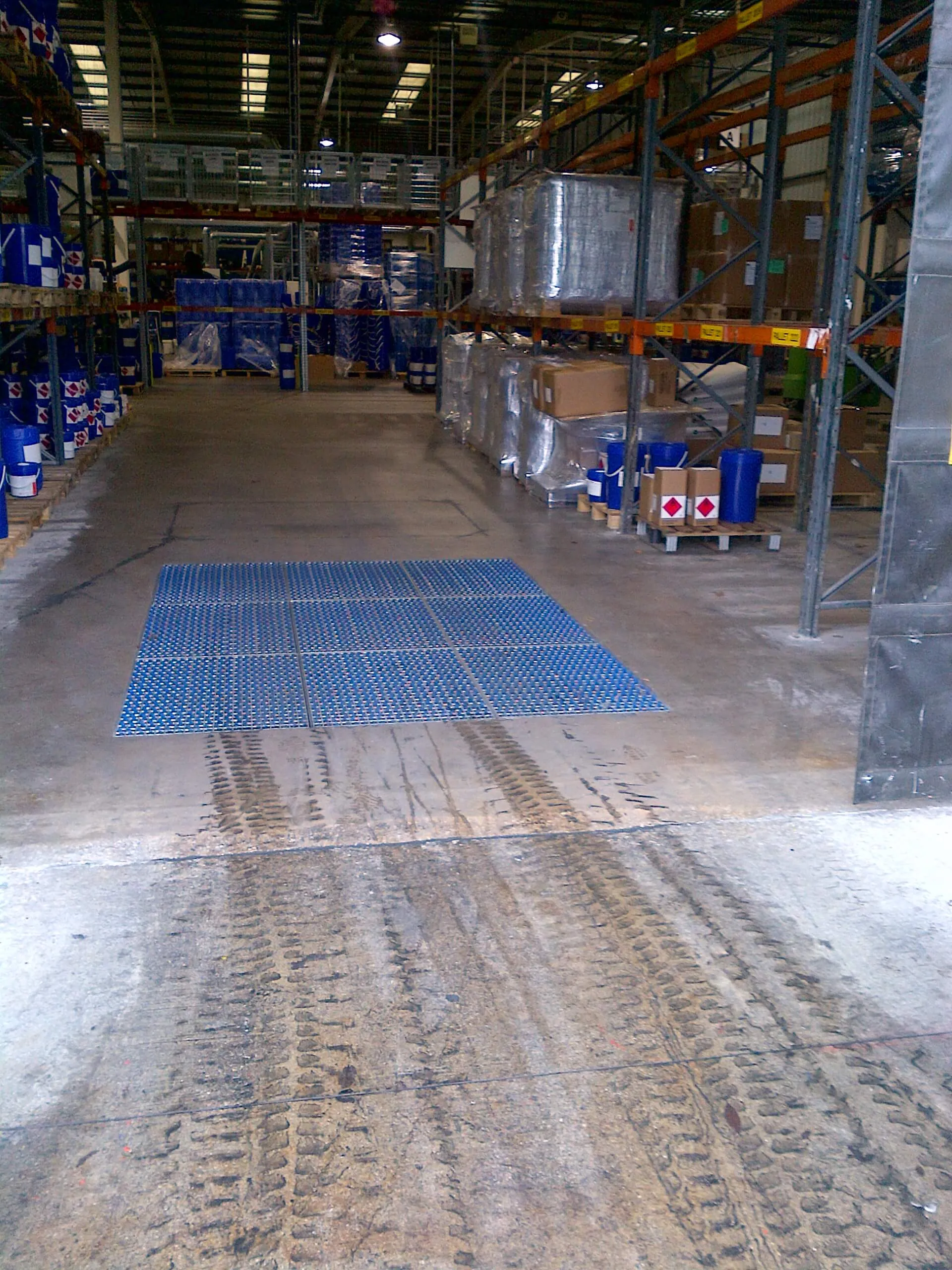
One less route between zones
Forklift tyres are one of the ways an organism travels from a yard or a raw materials area into a room where the product is open, and it is a route that leaves no trace until something is found downstream in a swab or a batch.
-
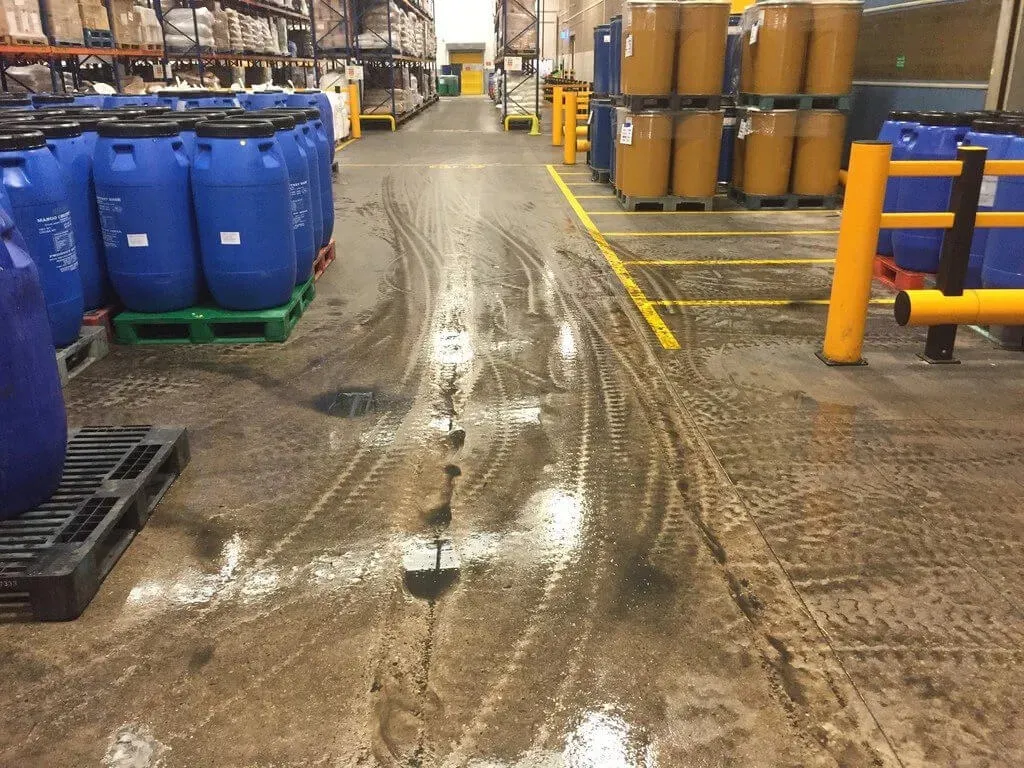
Nothing asked of the driver
The vehicle crosses at its normal operating speed and the cleaning happens because it crossed, so there is no stopping, no dismounting and no step that gets skipped when the shift is behind, which is usually when it would matter most.
-
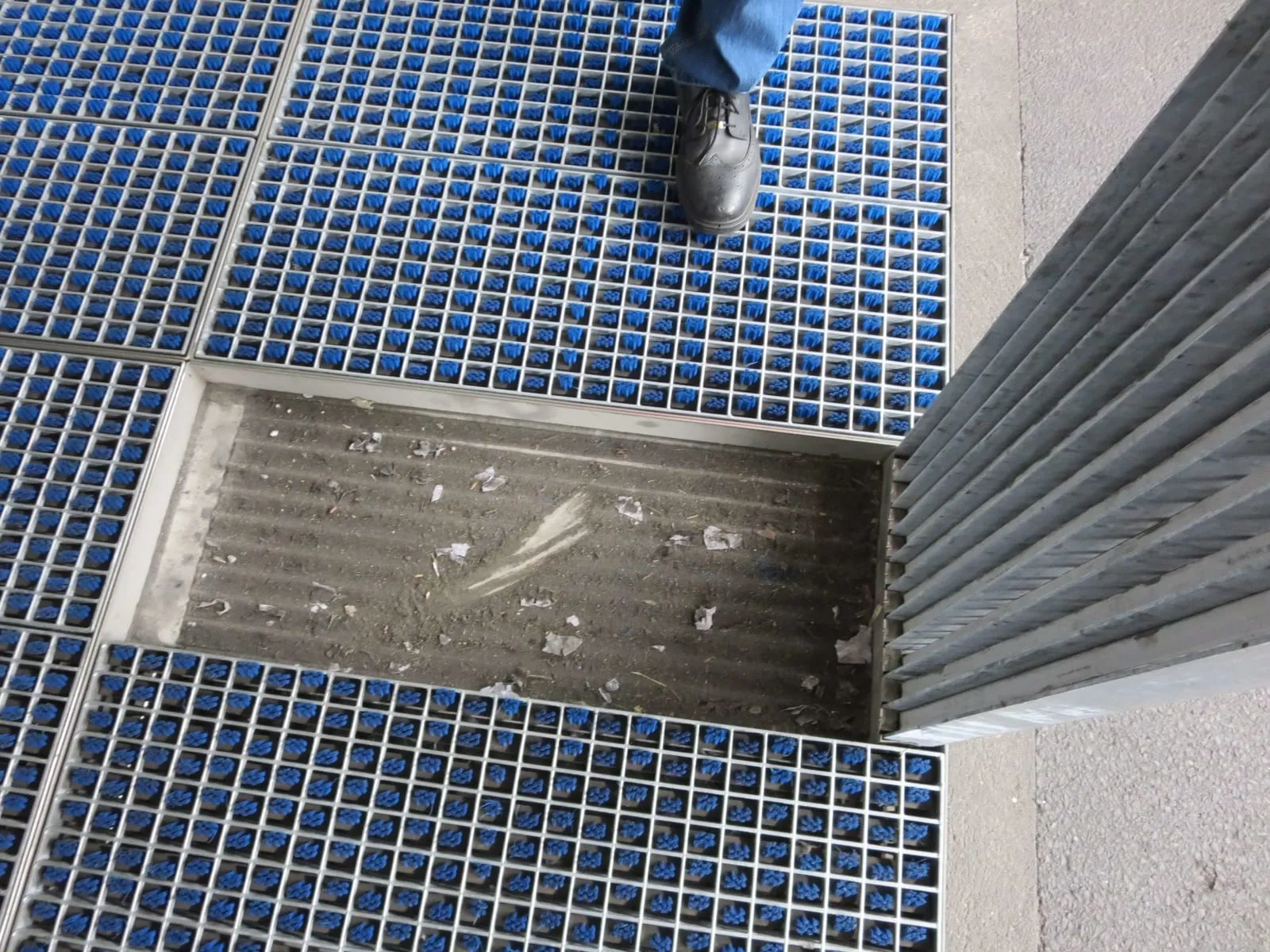
Maintenance that stays one person's job
The solution is drained and replaced on a rhythm that follows the traffic, and the tray is emptied at the same time. Individual panels lift out for cleaning or replacement without disturbing the rest of the field.


Why it works without a power supply
Nothing in the assembly is powered, and that is a property of the design rather than an economy: the cleaning force is the weight of the vehicle pressing the bristles against the tyre as it turns, so there is no sensor to fail, no control to be switched off and no supply to be found at a dock door, where power is rarely where you would want it.
The bristle is chosen to balance stiffness against flex memory, so that it scrapes rather than bending away under load and then returns to its original angle instead of laying flat after a season of traffic. That is what keeps a field working the same way in its third year as in its first, which matters more on a wet system than on a dry one, because here the consistency is part of what the hygiene plan is relying on.
It also means the running cost of the installation is the disinfectant and the maintenance rhythm, and nothing else.
Where the wet system is the right specification
A wet field earns its place wherever the thing being kept out is microbiological rather than visible, and where the consequence of getting it wrong is a batch, a recall or an audit finding rather than an hour of scrubbing.
- Food and beverage production, at the line between raw material intake and processing, and between processing and packing.
- Pharmaceutical manufacturing, in the approach zone to a controlled room, where EU GMP Annex 1 asks for a contamination control strategy that accounts for how material and equipment move.
- Laboratories and research facilities, where traffic crosses between areas held to different containment requirements.
- Chemical and process plants, where what is on the tyres is a housekeeping and a safety question at the same time.
- Cold stores and logistics buildings handling food, where the same forklifts cross between a yard and a temperature controlled room many times a shift.
What has been tested, and by whom
The wet system was tested by the University of Bonn together with the IBELIN laboratory, over a two metre cleaning field fed with disinfectant at 2 percent, and the reductions measured were 99 percent of Escherichia coli, 95 percent of Enterococcus faecium and 90 percent of Aspergillus niger spores.
That is the form in which Rejuva quotes a performance figure, with the institute, the organism and the conditions beside it, because a reduction rate belongs to the trial that produced it and not to the brochure that repeats it. What a particular doorway achieves depends on the traffic across it, on what that traffic carries and on how the field is sized, and establishing those three is what the site survey is for.
The bristle material complies with FDA requirements for indirect food contact, which is what makes the system suitable for installation inside a food production zone rather than only at its perimeter, and the panels carry anti-slip and flame resistance certification for wet industrial environments.
DIN EN ISO 13287, DIN 51130 and DIN 51131 for slip resistance, DIN EN 13501-1 for reaction to fire.
Controlling what gets into the building
Two other things Rejuva installs at the same boundary, for the sites where the wet field is one part of a wider contamination question.
-
Forklift wheel cleaning system
The dry half of the same product. Mechanical cleaning with no consumable and no solution to change, for the entrances where the problem is dirt, grit and water rather than bacteria.
-
Industrial air purifiers
The same argument applied to what is airborne rather than what is on the floor, for the halls where dust, welding fume or odour is the load that has to come down.
Frequently asked questions
How is this different from a dry wheel cleaning system?
The mechanical part is the same and the tray underneath is not. A dry system collects what the brushes take off and needs the tray emptying; a wet system holds a disinfectant solution at that level, so the cleaned surfaces are wetted in the same crossing. Choose the dry one where the problem is visible dirt and the wet one where a microbiological load is what the site is audited on.
Which disinfectant goes in it?
The one the site's hygiene plan already specifies, at the concentration that product is approved for. The installation does not decide the chemistry and Rejuva does not supply it as part of the system, because the choice belongs with whoever is responsible for the hygiene plan and with the approvals the site works under.
How often does the solution have to be changed?
On a rhythm set by the traffic across the field and by how dirty that traffic is, which is why it is established at the survey rather than quoted from a catalogue. Draining, refilling and emptying the tray is a routine task for one person and needs no special tools.
Does it slow the forklifts down?
No. Vehicles cross at their normal operating speed, and the cleaning happens as the wheels turn over the bristles, so there is nothing the driver does differently: no stopping, no reversing and no change of approach to the door.
Do we need particular tyres, or any change to the trucks?
None. The system works with pneumatic, solid rubber, polyurethane and cushion tyres, and with counterbalance forklifts, reach trucks, pallet trucks and powered pallet jacks alike. The panels take loads of up to 40 tonnes, so what needs checking before specifying is the weight of the heaviest vehicle that will cross rather than what it runs on.
Can it be installed in a building we lease?
A recessed tray means cutting into the slab, which a lease may not allow. Where it does not, a surface mounted frame with ramped edges sits on top of the existing floor and can be taken with you if the operation moves. The points to check first are the clearance under the door and where the liquid goes.
Does it work for people on foot as well?
Yes, the same field cleans and disinfects shoe soles, and on many sites the pedestrian door beside the vehicle door is treated at the same time. The sizing on this page is written for wheeled equipment, because a wheel has to turn across the brushes and a sole does not, which changes how long the field needs to be.
Will it satisfy our BRC or IFS audit?
It gives you an engineered, permanent control at the point where traffic crosses between hygiene zones, which is what those standards expect to find there, and it can be written into the cleaning procedure and evidenced. An auditor judges the system as installed and as operated, which is why the sizing and the maintenance rhythm carry as much weight as the equipment.
Related services
Projects rarely stop at one discipline. These are the services most often planned alongside this one.

Have a project in mind?
Describe what needs to happen in the building and we will come back with a proposed approach, the specialist who would carry it out and a budget you can work with.